
Home Depot Clearance Explained: How Markdowns Reach a Penny
The whole markdown lifecycle in one place: what clearance means at Home Depot, how prices step down, what the tags can and cannot tell you, and where the penny sits in all of it.
Most of what circulates about Home Depot clearance is either a photo of someone else's receipt or a chart of tag codes passed around like a treasure map. Both leave out the part that actually matters: clearance at Home Depot is a process, and once you understand the process, the receipts and the tag charts stop being mysterious. This guide walks the whole lifecycle, from the day an item is marked for removal to the day it rings up for a cent.
What “clearance” means at Home Depot
Clearance is what happens when a store decides an item is done. Maybe the product line was discontinued. Maybe a newer model replaced it. Maybe the season ended and the shelf space is needed for whatever comes next. Whatever the reason, the store stops treating the item as something to sell at full margin and starts treating it as something to get rid of. The price then steps down on a schedule until the item either sells or leaves the building.
The single most important fact about this process: it happens per store. Home Depot runs more than 2,000 US locations, and each one clears its own inventory. A drill that is half off in Marietta can be full price twenty minutes away in Kennesaw, because clearance depends on what each individual store ordered, what it sold, and what its manager needs off the floor. A national “Home Depot clearance list” is a contradiction in terms. There are only store-level lists.
This is also why clearance hunting rewards locals. The person who checks one store regularly will beat the person skimming a nationwide Facebook list every time, because the list describes someone else's store.
The markdown lifecycle, end to end
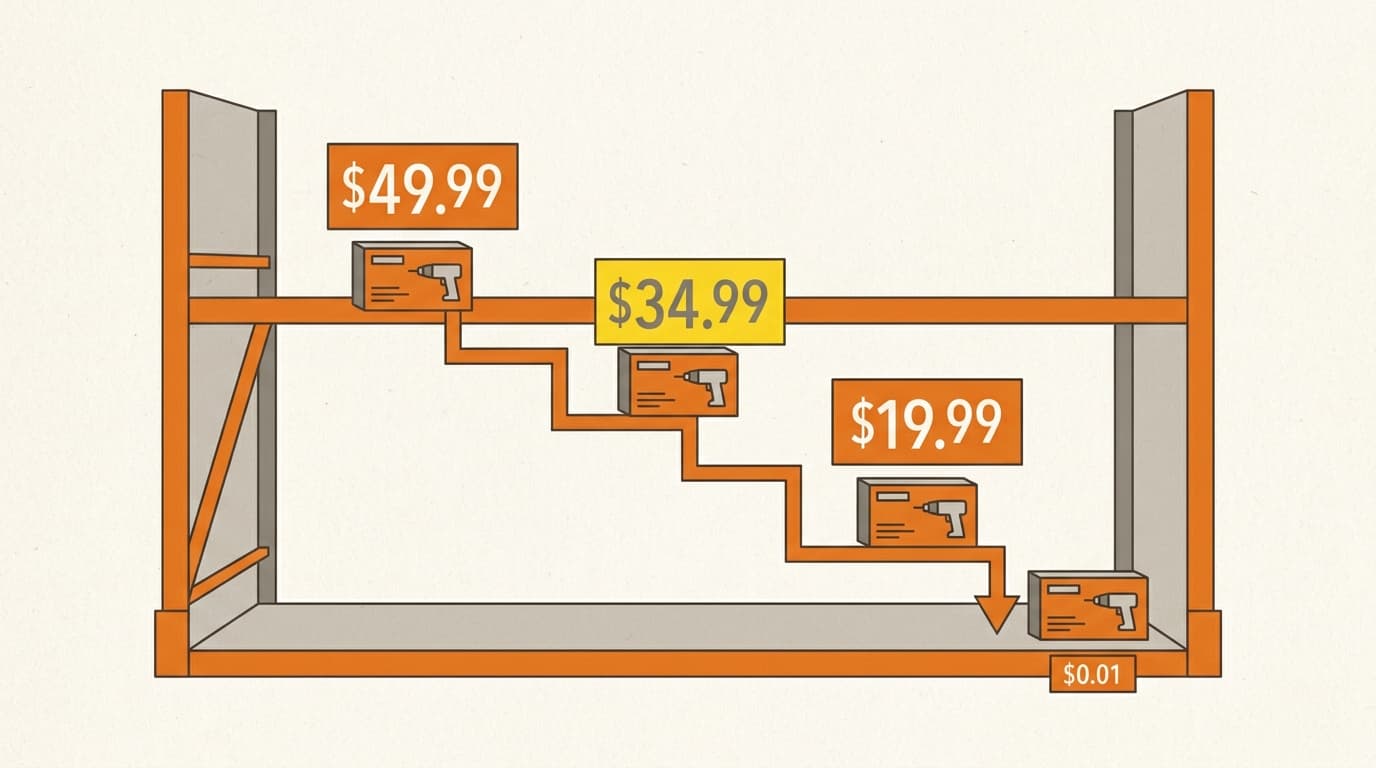
The pattern shoppers consistently report looks like a staircase. An item enters clearance at a modest discount, often somewhere around 25%. It sits at that price for a review period, commonly described as about six weeks at many stores. If it has not sold, the price steps down again, to 50%, then deeper. Items that survive every stage reach a final markdown, and a small fraction of those end at $0.01, the signal that the item should be pulled from the shelf entirely.
Two caveats keep this honest. First, the timing is not a published policy. The six-week rhythm comes from years of shopper observation, not from a Home Depot document, and individual stores deviate from it constantly. Second, most items never walk the full staircase. They sell somewhere in the middle, which is the point of marking them down. The deep endpoints are rare by design.
What this means in practice: the discount you see on a clearance tag tells you roughly where the item is in its lifecycle. A 25% tag is an item at the start, likely to get cheaper if it lasts. A 75% tag is an item near the end, where waiting longer risks losing it to another shopper. Reading clearance well is mostly about judging that trade-off item by item.
Reading the tag
The tag on the shelf carries more information than the price. The markdown date is printed on it, which tells you when the current stage started and, if the six-week pattern holds at your store, when the next drop might come. Tag color matters too: shoppers widely report yellow tags for clearance against white tags for regular prices, so a yellow tag is your cue to look closer.
Then there is the famous price-ending theory, the claim that a price ending in .06 means one stage and .03 means another. We wrote a full breakdown of the tag-ending codes and the short version is: treat it as folklore with a loose basis in reality, not a lookup table. Home Depot has never confirmed it, the pattern varies by store and category, and the people repeating it with the most confidence tend to be quoting each other.
The one tag-reading rule that is always true: the printed tag and the register can disagree. The system price changes before anyone walks the aisle with a label gun. Scan the item with the Home Depot app or a store kiosk and you get the current price; trust the paper and you get the price as of whenever the tag was printed.
The penny endpoint
Penny items are the part of this process that goes viral, so it is worth being precise about what they are. A penny price is not a secret sale and not a separate program. It is the final state of the markdown lifecycle: the system marking an item as terminated, at which point staff are supposed to pull it from the shelf and dispose of it. The ones shoppers find are the ones the pull process missed.
That has two practical consequences. Finding a penny item is partly a timing game, catching the window between the system update and the shelf sweep. And stores are not thrilled about it: a penny sale is a process failure from their side of the counter, which is why registers sometimes decline them and why waving one around rarely goes well. Our complete penny items guide covers the etiquette, the mechanics, and the realistic odds in detail.
The framing that keeps expectations sane: pennies are the tail of clearance, not the point of it. A shopper who chases only pennies walks past 90% markdowns to hunt for a 99.99% one that was probably pulled on Tuesday. The reliable money is in the middle of the staircase.
Where the markdowns actually show up
Not every department clears inventory at the same rate. Watching our own daily scans across 167 stores, a few patterns repeat:
- Seasonal is the metronome. Patio furniture, grills, and garden in late summer; holiday decor in January; heaters in spring. Seasonal resets are the largest and most predictable clearance events in the building, because the shelf space has a hard deadline.
- Tools and hardware clear on model cycles. When a combo kit gets a new SKU, the old kit goes to clearance, and tool clearance runs deep because the outgoing model is nearly identical to the new one.
- Lighting, tile, and decor clear on discontinuations. Style turnover does the work here. A tile line that gets dropped can step down fast, and because tile is heavy and annoying to ship between stores, it tends to ride the full staircase locally.
- Appliances clear as open-box and display units, which is its own lane: fewer items, bigger dollar discounts, and condition matters as much as price.
None of this is a rulebook. It is a description of where the volume is, so you know which aisles repay a regular walk.
How to find markdowns at your own store
Since clearance is per store, the practical question is always: what is marked down at my store, today? There are four honest ways to answer it.
Walk the store. The endcaps and the back corners of seasonal, plus a scan of anything with a yellow tag. Free, reliable, and limited by how often you can physically show up.
Use homedepot.com and the app. Set your store and filter for clearance or check an item's local price. Accurate for one item at a time, but there is no good way to see everything your store just marked down; the site is built to sell you things, not to report on markdowns.
Follow deal communities. Facebook groups and forums surface real finds, with the structural limit that every post describes someone else's store and arrived after the poster already bought theirs. Third-party lookup tools have their own staleness problems, which we walk through in our comparison of BrickSeek alternatives.
Use a scanner that watches your store. This is the gap myStoreAlert exists to fill: we scan store-level pricing daily and publish what each store actually had marked down, dated, with the store number attached. You can browse the public version by location on our state and city clearance pages, which run 48 hours behind, and members see the current scan for their own store.
What no tool can promise
Any honest description of clearance hunting has to end with the limits, because the limits are structural.
Stock moves. A clearance item is by definition one the store is not restocking, so every listing anywhere, including ours, describes the past. The item that was there this morning may be in someone else's cart now.
Registers decline. Stores can refuse an unusually low price at checkout, especially a penny, and the associate at the register did not design the markdown system and cannot override store policy. Arguing with them wastes everyone's afternoon.
And prices differ between stores by design, so a find in one ZIP code proves nothing about yours. Verify in store, every time, before driving anywhere for a deal. A tool can shrink the guesswork; nothing eliminates it.
Frequently asked questions
Does Home Depot have official clearance days?
No published ones. Shoppers report markdown activity clustering early in the week at many stores, but this varies by location and nothing official confirms a schedule. The tag date is a better signal than the calendar.
Can I ask staff what is about to be marked down?
You can ask whether an item is being discontinued, and staff will often tell you. Asking for the markdown schedule itself rarely works; most associates do not have it, and the ones who do are not supposed to share it.
Is online clearance the same as in-store clearance?
No. Online clearance is a separate pool of inventory with its own pricing. The deep in-store markdowns, and all penny items, exist only on physical shelves at specific stores, which is exactly why they are hard to find from a couch.
The short version
Clearance at Home Depot is a per-store staircase: an item gets marked for removal, steps down in price on a roughly six-week rhythm, and ends at a penny only if nobody buys it first. The tag tells you the stage, the register tells you the truth, and the whole game is knowing what your own store marked down before everyone else does. That last part is what we automate. Start a free 7-day trial and see your store's current scan, or browse the delayed public feed on the clearance pages first.
Related reading
- Home Depot Penny Items: The Complete Guide (2026)
- Home Depot Clearance Tag Endings Decoded
- How to Read a Home Depot Clearance Tag in the Aisle
- Home Depot Clearance Schedule: How the Markdown Cycle Works
- Home Depot Clearance Roundup, Verified August 2026
- Which Home Depot Departments Get the Deepest Markdowns
- BrickSeek Alternatives for Home Depot Clearance (2026)